
Transcript
Announcer:
Welcome to CE on ReachMD. This activity is provided by Global Learning Collaborativeand is part of our MinuteCE curriculum.
Prior to beginning the activity, please be sure to review the faculty and commercial support disclosure statements as well as the learning objectives.
Dr. Hicks:
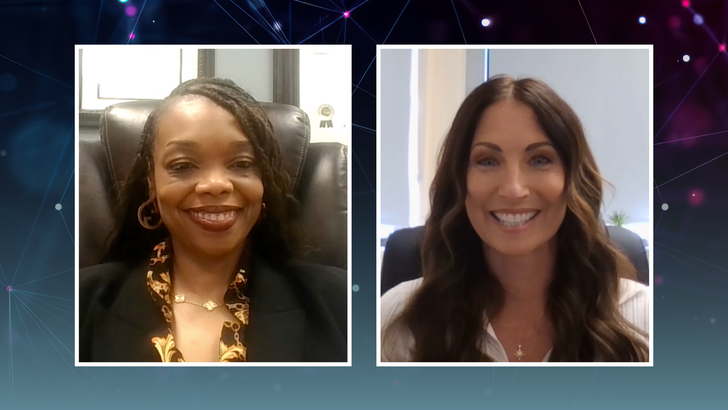
This is a CE on ReachMD. I'm Dr. Tracy Hicks, and with me, I have Dr. Melissa Moody. Today, we're discussing how to implement a quick screening for tardive dyskinesia into routine office visits.
So Melissa, how do you approach TD screening in your practice?
Dr. Moody:
Tracy, I have found that every office does this differently. What we do here is work as a team to try to identify any abnormal movement.
On my part, I make sure that I take a really thorough history. Doing that clinical interview, doing that history of medications, looking at the risk factors that each individual patient has, how long they've been on medication, maybe the different types of medication they've been on, if they've had any other drug-induced movement disorders, those are all risk factors, right, for developing tardive dyskinesia. So the first thing on my part is making sure that I take that very thorough history and really get in there and get those details that I really need.
I then perform a detailed physical exam focusing on facial, oral, limb, and trunk movements. I ask my patients to take their shoes off. And then I also take note of any changes or unusual things that happen when I see my patients repeatedly. For example, sometimes I have patients who will show up in the middle of winter wearing open-toed sandals because they have involuntary movement of their toes. When I see things like that, I ask questions—why are you wearing slide shoes today or sandals today? Why aren't you wearing a pair of winter boots? And patients will sometimes tell you, “Well, I wear blisters on my toes because they move so often in my shoes.” So I try to take notes of things like that.
In addition to that, I'll ask family members or caregivers about any observed abnormal changes or movements that they've seen in their loved one.
I also ask that my registration staff be aware of patients’ behavior in the waiting area, and they keep an eye for any abnormal or unusual movement or anything that looks like it could be involuntary, then they bring that to me and let me know, “We noticed this for this patient, it may be worth exploring more.”
I also use standardized scales like the AIMS, or the Abnormal Involuntary Movement Scale, which is a systematic way to assess that movement, and it often is a good place to start to give me a baseline of what their movement looks like and where that movement is involved.
Do you do something similar in your practice? What do you do in your practice, Tracy?
Dr. Hicks:
I do do something similar, Melissa. I love what you said about the team, because again, there's no I in team, right? You use the entire team. So my front desk staff from the front to the back, if they identify something, as providers we're very comfortable with taking that information from them and making sure that we do what we need to do for the patient, because again, we are all here for the patients.
Dr. Moody:
Great. What about monitoring for patients along the way? Is there something that we should do when we see a patient who maybe has tardive dyskinesia and we diagnose it? And then we treat? Are there certain things that you do in your practice to monitor and follow them as they go along?
Dr. Hicks:
Melissa, it's all about building rapport, right? Because we know—I've talked to people across the country, and people aren't so comfortable talking about abnormal movements. So we have to ensure that we build that rapport, right, so we can have those conversations.
And then we want to ask open-ended questions, right? I noticed that you have the movements in your mouth. Of course, we have to build the rapport before we ask that question. Then, how is that impacting your life? And including the caregivers in that conversation.
Dr. Moody:
Those are great points, Tracy. Great points.
Dr. Hicks:
Well, Melissa, this has been a great micro discussion. Thank you everyone for listening.
Dr. Moody:
We'll see you next time.
Announcer:
You have been listening to CE on ReachMD. This activity is provided by Global Learning Collaborativeand is part of our MinuteCE curriculum.
To receive your free CE credit, or to download this activity, go to ReachMD.com/CME. Thank you for listening.
 In support of improving patient care, Global Learning Collaborative (GLC) is jointly accredited by the Accreditation Council for Continuing Medical Education (ACCME), the Accreditation Council for Pharmacy Education (ACPE), and the American Nurses Credentialing Center (ANCC) to provide continuing education for the healthcare team.
  Global Learning Collaborative (GLC) designates this activity for 1.00 contact hour(s)/0.10 CEUs of pharmacy contact hour(s).
  Global Learning Collaborative (GLC) has been authorized by the American Academy of PAs (AAPA) to award AAPA Category 1 CME credit(s) for activities planned in accordance with AAPA CME Criteria. This activity is designated for 1.00 AAPA Category 1 CME credit(s). Approval is valid until 05/14/2027. PAs should claim only the credit commensurate with the extent of their participation in the activity.