Transcript
Announcer:
You’re listening to NeuroFrontiers on ReachMD, and this episode is supported by UCB. Here’s your host, Dr. Charles Turck.
Dr. Turck:
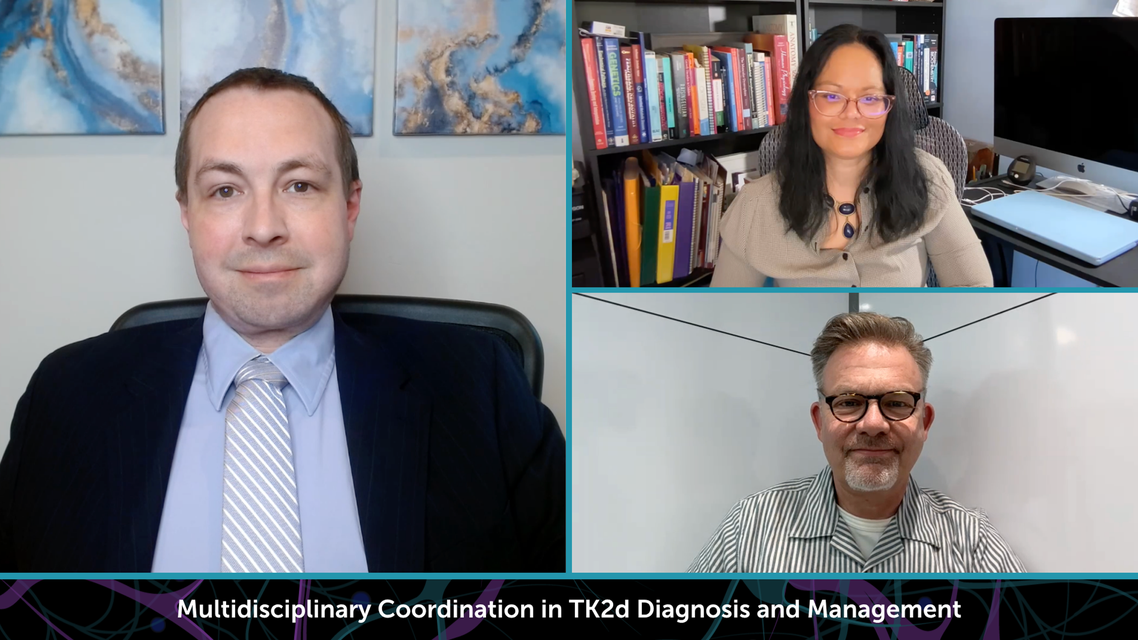
This is NeuroFrontiers on ReachMD, and I'm Dr. Charles Turck. Joining me to share strategies for improving multidisciplinary collaboration and supporting the early recognition and management of thymidine kinase II deficiency, or TK2d for short, are Drs. Hank Mayer as well as Zuela Zolkipli-Cunningham. Dr. Mayer is an attending pulmonologist and the Director of the Pulmonary Function Laboratory at Children's Hospital of Philadelphia. Hank, thanks for being here today.
Dr. Mayer:
Thanks very much for the invitation. It's a pleasure to be here.
Dr. Turck:
Also joining us from the Children's Hospital of Philadelphia is Dr. Zolkipli-Cunningham, who's an attending physician and the Director of Clinical Research in the Mitochondrial Medicine Frontier Program. She's also an Assistant Professor of Pediatrics at the University of Pennsylvania Perelman School of Medicine. Zuela, welcome to the program.
Dr. Zolkipli-Cunningham:
Delighted to be here. Thank you.
Dr. Turck:
Well, let's hear from you first, Zuela. From your perspective, what are some of the early multisystem patterns that may point toward a diagnosis of TK2d?
Dr. Zolkipli-Cunningham:
I think at this stage, it's important to say that the age of onset can be anywhere from early childhood to adulthood—even late adulthood by that. Therefore, the presentations would look different.
In an adult, it'd be very neuromuscular. It would look like a neuromuscular disorder, so there’d be muscle weakness, bilateral ptosis where your eyelids droop, swallow difficulties, voice hoarseness, and potentially things like weight loss secondary to difficulty with feeding due to dysphagia. The muscle weakness could affect any parts of the limbs, but typically, it’s proximal myopathy, so proximal muscle weakness in the hip and shoulder girdle muscles and also the facial musculature. So it looks, as I said, very muscular in presentation.
In a child, too, it would present in their growth as well as potentially development because of the impaired motor milestones secondary to muscle weakness. And so as you see, it presents in a slightly different way in a child. And children, of course, are growing and developing, and so there's a great potential impact on those aspects.
Dr. Turck:
Turning to you now, Hank, to zero in on the pulmonology side of things, what respiratory findings tend to raise suspicion for an underlying neuromuscular or mitochondrial disorder like TK2d, and how can pulmonologists shorten the path to diagnosis?
Dr. Mayer:
For patients with progressive neuromuscular disease that causes hypotonia and loss of function, the pulmonary manifestations that we typically see are in two categories. One would be the inability to breathe in deeply and then forcefully exhale or cough. The second would be a loss of the ability to bring in oxygen and remove carbon dioxide, which we call ventilation.
The focus of secretion clearance or airway clearance is obviously during an acute respiratory illness. And so if a child were to have an illness that would last beyond the five to seven days that a typical cold would last, that would make me concerned about an underlying hypotonic neuromuscular condition. And then if patients are not sleeping well at night and are not getting the same restorative sleep that they have in the past, then that would make me concerned about the possibility of the child having disrupted sleep, which could certainly within the realm of hypotonic neuromuscular disease be due to hypoventilation.
Now, if we talk about mitochondrial conditions, the other thing that would get me concerned is about having a much more dramatic loss of muscle function during an acute illness, specifically respiratory function. And when we see that specifically, that would get me concerned about the potential for a mitochondrial condition on top. It would not be diagnostic by any sense, but it would certainly prompt me to make a referral to a colleague who's better equipped to make a diagnosis.
Dr. Turck:
Now, fragmented care is often one of the biggest barriers to timely diagnosis. So if we come back to you, Zuela, what practical strategies have you found most effective for improving referral coordination and communication between specialties during the diagnostic process?
Dr. Zolkipli-Cunningham:
Yeah, I think it's a really important point in order to capture these patients quicker. So the issue is that if they are going to present with a chest infection, it might be to the emergency room or their primary care doctors; these patients can present anywhere. It might be a GI doctor, or it might be an endocrinology doctor.
So the most important thing to state is awareness—first of mitochondrial myopathies in general, and then awareness of TK2 myopathy specifically because there's better access to molecular confirmation nowadays and clinical management. I think that the most important thing that the mitochondrial disease community can do is, as physicians, raise awareness through education.
When physicians who are not so used to seeing patients with TK2 deficiency are concerned that this might be the diagnosis or are considering a neuromuscular disorder, it would be important for them to know who to reach out to—as Hank mentioned earlier, reach out to the people who are equipped to make the diagnosis. So we have structures in place internally within each system or within an institution for colleagues to reach out to each other and understand the genetic diagnosis to be an urgent issue, primarily through grand rounds, our electronic medical records, and collegial collaboration within the institution. At the end of the day, I think communication, collaboration, and education are really the basis of ensuring these patients are detected.
Dr. Turck:
For those just tuning in, this is NeuroFrontiers on ReachMD. I'm Dr. Charles Turck, and I'm speaking with Drs. Hank Mayer as well as Zuela Zolkipli-Cunningham about coordinating care in the diagnosis and management of thymidine kinase 2 deficiency, or TK2d.
So, Hank, once patients are diagnosed with TK2d, how does ongoing pulmonary surveillance fit into the broader multidisciplinary care model?
Dr. Mayer:
So what we do are two things. The first is we lay out a scenario of signs of respiratory muscle dysfunction, and then on top of that, we do prospective studies that can give us data that would indicate progressive weakness.
And so the first thing that I worry about is the ability or inability to cough and clear secretions. That's usually the first sign of a progressive respiratory muscle function occurring in somebody with a hypotonic neuromuscular disease. And so we talk about tracking duration and severity of illness and ensuring that a patient is continuing to be able to expectorate clear secretions at the same intensity and within the same time period that it has occurred in the past.
And then over top of that, we can lay pulmonary function testing that we can do in our office on a regular basis to track the ability to breathe in deeply and breathe out as far as they can, something called spirometry. And we get a value called forced vital capacity, which measures the maximum amount of air that a patient can breathe into the lungs and then out of the lungs when they breathe in as deeply as possible, which tests diaphragm function, and then breathe out as far as they can, which tests abdominal or expiratory muscle function. And then in addition, we have two tests—the maximum inspiratory pressure and maximum expiratory pressure measurements—that we can use in conjunction with spirometry to track respiratory muscle function.
And if we are able to collect longitudinal data over time, if we see an abrupt decline in one of those two values, then that would make us concerned about loss of function. And depending on where the data are, that may prompt us then to do more discrete testing, such as doing a sleep study to evaluate for nocturnal hypoventilation or under-breathing or perhaps assess somebody for use of an assisted cough device.
Dr. Turck:
Now, multidisciplinary clinics are increasingly being used to support patients with rare neuromuscular diseases like TK2d. Based on your experience, Zuela, what are the most meaningful real-world effects of these coordinated care models when it comes to diagnostic efficiency, nutritional support, and ongoing symptom management?
Dr. Zolkipli-Cunningham:
I mean, I think you said it all there, Charles. The most important thing is the patients have so many appointments to make. There are patients with involvement in any organ system in the body. This is what happens with mitochondrial disease. Patients share that they spend their Easter break or their Christmas break coming into hospital for all their appointments.
So it is extremely helpful and beneficial to them based on patient reporting and feedback that we set up Multi-D clinics. The Multi-D clinic can be any combination, but really what we're doing is enhancing communication among professionals who see the patients. Patients, I find, particularly appreciate it when we're discussing their cases and their challenging decision-making in front of them, with them, and being involved. So having three or four professionals in the room with the patient and their family involved is a very effective way of ensuring everybody's on the same page.
Dr. Turck:
Well, let's come back to you, Hank, for the final word. Given the advantages Zuela just talked about, how can healthcare systems build connected care networks that support earlier recognition and more consistent long-term management?
Dr. Mayer:
Yeah, thank you for the question. I think it's a very important topic, and the issue is that healthcare systems need to be willing to invest the personnel, the space, and the time to have the opportunity to have multidisciplinary neuromuscular clinics. And the advantage of doing so brings the providers together and can reduce challenges in communication and optimizing care, which ultimately improves the long-term care and quality of care for the patients that we're serving.
Dr. Turck:
Well, with those final strategies in mind, I want to thank my guests, Drs. Hank Mayer and Zuela Zolkipli-Cunningham, for joining me to discuss how we can build multidisciplinary care models to improve the diagnosis and long-term management of thymidine kinase 2 deficiency. Hank, Zuela, it was great having you both on the program.
Dr. Mayer:
Thanks very much for the invitation. It was a pleasure to have our discussion today.
Dr. Zolkipli-Cunningham:
Yeah, it’s an excellent and important topic. So thank you for highlighting this issue.
Announcer:
This episode of NeuroFrontiers was supported by UCB. To access this and other episodes in our series, visit NeuroFrontiers on ReachMD.com, where you can Be Part of the Knowledge. Thanks for listening!