
Transcript
Announcer:
You’re listening to GLC on ReachMD. This activity is provided by Medcon and is part of our MinuteCE curriculum.
Prior to beginning the activity, please be sure to review the faculty and commercial support disclosure statements as well as the learning objectives.
Episode 6
Dr. Cabral:
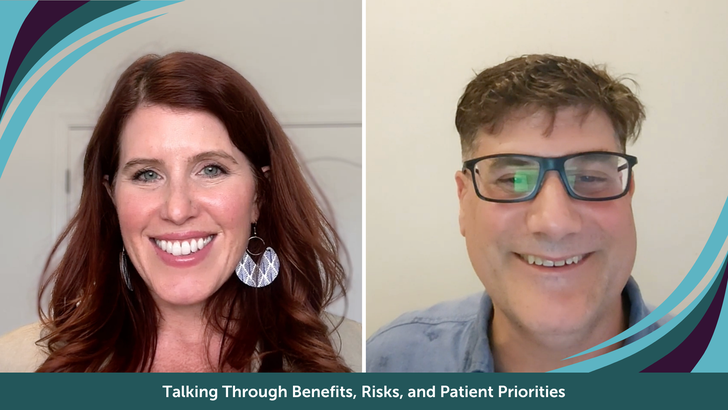
I'm Dr. Cabral, here today with Dr. Weisman.
Perhaps the most important part of care isn't just selecting a treatment; it's helping patients and care partners make informed decisions together. Dr. Weisman, how do you approach conversations about the benefits, limitations, and risks of amyloid-targeting therapy?
Dr. Weisman:
I set the stage. I think the approach of that conversation has to begin the very first time you meet the patient and the caregiver, which can actually kind of go off the rails pretty quickly. But if they see you as someone that they should trust and, you've said it previously, in their corner, on their side, have their back. “Is this a person who has my back, or is this a doctor who's just going through the motions and just dotting an i? Am I just an i?”
So they're picking up on stuff like that right away. So a lot of what's happened has been emotional content that has a resonance and plays a part in the discussion that you're having during the consent. So pay attention to that stuff. Right? The priors are really important. You have a relationship with this patient based on the first second you meet them, the first impression.
But then the information is really important that they get that we're interested in slowing down disease. It's not a cure. It's not going to prevent them from getting completely bad. It's going to slow things down but not arrest the disease. They can understand that.
Safety considerations, why we're doing all these MRIs, their personal ARIA risk, the personal risk of their brain swelling, and then the burden of treatment. All that has to be entertained, fleshed out. What's our plan for how to make that work? And all their goals for life, right? A lot of them have goals. They want to see their grandchildren graduate. They want to see their children, actually sometimes, graduate high school and college.
And at the end of the day, it's a shared decision-making. But that's the way to make it a wise decision as opposed to an impulsive bad decision, meaning like a decision that's not rested on good information and good trust. Right? At the end of the day, I think whatever the decision is—“yes, I want the therapy;” “no, I don't”—I'm happy because a decision has been made. It's bothersome to me that if an indecision occurs, and that is troublesome to me. That's bothersome. I guess I have to get over it.
How about you, Dr. Cabral, any other pearls for us?
Dr. Cabral:
Yeah. Well, and I would just add keeping in mind we have people in front of us who have memory loss and we're telling them about this serious medication with potential serious side effects. So to give them information to review after with the initial conversation moving forward. And that could be handouts. That could be video. And so we need to rely on these tools for everybody because it's a big decision. But ultimately it needs to happen in a set time frame, right? So not too quickly, but there needs to be closure, whether it's moving forward or not. Like you said, indecision is the worst thing, and you don't want people to regret or feel like things are left not tied up.
Dr. Weisman:
And time is brain. We say that, but even if they delay care by 3 months, 6 months, I feel the disease is going to get worse. They're never going to get that time back. And I've had patients who I've said, “Listen, I've had a discussion with you before for a long time, and another one, and that was our third discussion. We're not going to be having another one.” Right? Because time is ticking, and you're going through the appropriate window here.
Dr. Cabral:
And I would say we have older adults that are retired often, and they're like, “Well, I have this trip planned, and I don't”—right? So there's more and more data that the sooner you start this, the more effective it is. And so I really make it clear. To me, I have a 6-month kind of travel restriction in terms of, please don't go far away from a large medical center. Don't go on a cruise to Alaska. But after 6 months, that risk gets much less, and so people can wrap their brain around that, or I can deal with that.
Dr. Weisman:
Yeah, that's good. And they have some skin in the game. They’re kind of like, "I'm going to do my thing, put my time in." I like that.
Dr. Cabral:
Great. Well, this has been a fantastic bite-sized discussion once again. Our time is up. Thanks for listening.
Announcer:
You have been listening to GLC on ReachMD. This activity is provided by Medcon and is part of our MinuteCE curriculum.
To receive your free CE credit, or to download this activity, go to ReachMD.com/CME. Thank you for listening.
 In support of improving patient care, Global Learning Collaborative (GLC) is jointly accredited by the Accreditation Council for Continuing Medical Education (ACCME), the Accreditation Council for Pharmacy Education (ACPE), and the American Nurses Credentialing Center (ANCC) to provide continuing education for the healthcare team.
  Global Learning Collaborative (GLC) has been authorized by the American Academy of Physician Associates (AAPA) to award AAPA Category 1 CME credit for activities planned in accordance with AAPA CME Criteria. This activity is designated for 0.50 AAPA Category 1 CME credit(s). Approval is valid until September 16, 2027. PAs should claim only the credit commensurate with the extent of their participation in the activity.
 Global Learning Collaborative (GLC) designates this activity for a maximum of 0.50 contact hour(s)/0.05 CEUs of pharmacy continuing education credit.
 This activity has been accredited by the European Board for Accreditation of Continuing Education for Health Professionals (EBAC