
Transcript
Announcer:
You’re listening to GLC on ReachMD. This activity is provided by Medcon and is part of our MinuteCE curriculum.
Prior to beginning the activity, please be sure to review the faculty and commercial support disclosure statements as well as the learning objectives.
Episode 1
Dr. Weisman:
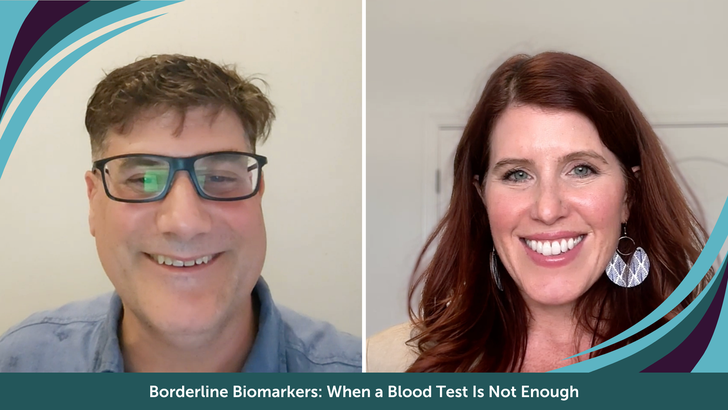
Hi, I'm Dr. David Weisman, and here with me today is Dr. Cabral. Today, we are discussing one of the biggest changes in Alzheimer's diagnosis: the increasing use of blood-based biomarkers.
Borderline biomarker results are becoming increasingly common, so a question is coming up: How should clinicians interpret these findings within the broader clinical picture? Dr. Cabral?
Dr. Cabral:
Thanks, Dr. Weisman. Yes, so blood-based biomarkers have moved so quickly through development and to practice that, as can happen, science is ahead of the clinical guidance. So there's lots of clinicians that are still trying to calibrate how much weight we give to this number that they receive.
So the first thing that I tell my colleagues is that the blood biomarker result is not a “yes” or “no” answer. It's a probability shift. And so if we think about these blood biomarkers, they're high quality and reliable and accurate, certain assays, but in older adults who are symptomatic, right? And so when we do one of these blood tests, it's so important to know the pre-test probability. So I want to say that again: pre-test probability.
Now, this term is coming into my life more than it ever has, and so the question is not, “What did the test say?” or “What were the results?” It was, “What are the characteristics of the patient that did the test?” Right? And so the predictive value of the result is based on the pre-test probability.
And so what impacts the probability that someone will have Alzheimer's pathology? So in other words, if you did this blood test, and it was p-tau217 or the amyloid-to-tau ratio, you know that the same result is going to mean something completely different if it's in a 65-year-old with memory loss versus a 45-year-old with maybe some brain fog, right?
And so what factors impact that pre-test probability? So age, for sure. And then, what are the cognitive symptoms or the phenotype? Does this look like Alzheimer's disease? And are there any comorbidities? So we know that chronic kidney disease and other things like anemia and low BMI can impact and skew the results. So they're not actually accurate anymore. So that's crucial.
Now, when the result actually falls you know in the indeterminate zone, this is the toughest part, when there's borderline results. And so at that point, knowing that clinical context is crucial, and in terms of not just what the clinical context is, but what are the stakes or the risks that we're wrong? And so should we pursue confirmatory testing?
So I call myself an Alzheimer specialist. You are as well. And so I have a low threshold to move to that confirmatory testing with the cerebrospinal fluid or the amyloid PET when the blood test result is borderline.
So we're looking at indications for when you're going to push towards confirmatory testing. And so when there's discordance between the result that you get, besides if it's borderline, and there's a clinical reason to do the additional test. So if the blood biomarker result is different than what we expect and it looks like Alzheimer's yet, say, it's negative, and there might be a treatment consideration, we're going to pursue that additional testing.
And so the new treatments that we have available, the anti-amyloid therapy, is really important for determining if we're going to push this farther. So this is an exciting time.
So once again, I'll say pre-test probability and really be open to doing that confirmatory test to make sure that we have accurate findings for the person sitting in front of us.
Dr. Weisman:
It's happened to me. I mean, many times I've had the clinical context, as you said, exactly on par with mild cognitive impairment or early Alzheimer's disease. I can kind of smell the amyloid, and yet it's borderline negative. And you know that in that setting, that's a false negative.
Dr. Cabral:
Yes.
Dr. Weisman:
And when you push forward into an amyloid PET scan, then it's almost universally positive, in my experience, and it'll have low Centiloid values. So the Centiloid values will not be 130; they'll be more like 35. Has that been your experience?
Dr. Cabral:
I've had it go both ways, where the patient's amnestic and they're older, it looks like Alzheimer's, but you know those people had other comorbidities, so it did obscure. It wasn't just like a healthy person otherwise. So I think that's an important piece.
And I did want to mention something that I didn't share. So when the blood test is negative and the person has a low pre-test probability, that's kind of a slam dunk for like we can rule out Alzheimer's at this point.
But thanks for sharing your personal experience. That's so meaningful. And so I think we have a great bite-sized discussion. Our time is up, so thanks for listening.
Announcer:
You have been listening to GLC on ReachMD. This activity is provided by Medcon and is part of our MinuteCE curriculum.
To receive your free CE credit, or to download this activity, go to ReachMD.com/CME. Thank you for listening.
 In support of improving patient care, Global Learning Collaborative (GLC) is jointly accredited by the Accreditation Council for Continuing Medical Education (ACCME), the Accreditation Council for Pharmacy Education (ACPE), and the American Nurses Credentialing Center (ANCC) to provide continuing education for the healthcare team.
  Global Learning Collaborative (GLC) has been authorized by the American Academy of Physician Associates (AAPA) to award AAPA Category 1 CME credit for activities planned in accordance with AAPA CME Criteria. This activity is designated for 0.50 AAPA Category 1 CME credit(s). Approval is valid until September 16, 2027. PAs should claim only the credit commensurate with the extent of their participation in the activity.
 Global Learning Collaborative (GLC) designates this activity for a maximum of 0.50 contact hour(s)/0.05 CEUs of pharmacy continuing education credit.
 This activity has been accredited by the European Board for Accreditation of Continuing Education for Health Professionals (EBAC