
Transcript
Announcer:
Welcome to CE on ReachMD. This activity is provided by TotalCME. This episode is part of our MinuteCE curriculum.
Prior to beginning the activity, please be sure to review the faculty and commercial support disclosure statements as well as the learning objectives.
Dr. Weihl:
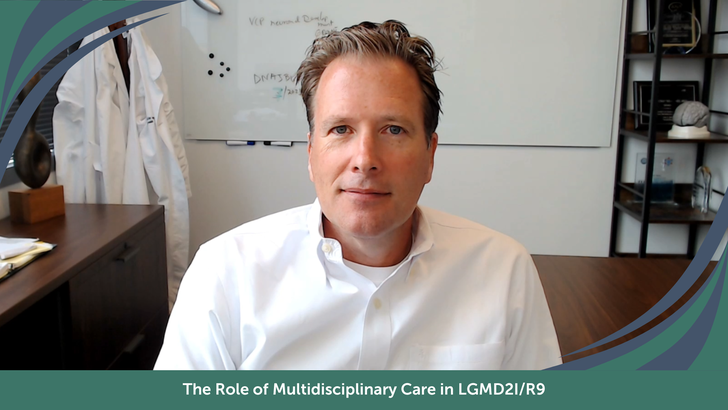
So this is CME on ReachMD. I'm Conrad Weihl, and today I'm going to be talking about multidisciplinary care in limb-girdle muscular dystrophy type R9/2I.
As a clinician that cares for patients with muscular dystrophies, I need a team to help me. It can't just be me as the clinician. And in fact, as the patients progress, I need even more help. And so I may be able to help make the diagnosis, which is important, but as far as being able to develop a team that can help support these patients throughout their journey and their life, it takes several individuals.
And so looking for a multidisciplinary team, meaning that a group that is all there together in clinic at once to help the burden of the patient so they don't have to go to several different clinics and can actually come to one, is really helpful. And so a multidisciplinary clinic, when I think of it for this group of patients, requires a neurologist but also physical therapists and occupational therapists, a pulmonologist. So we do a routine respiratory testing every time we see the patient to monitor their breathing and to help guide when interventions for breathing might be necessary. A nutritionist can be helpful.
The other important aspect, in this disease in particular, is cardiology. And so we actually have a cardiologist and can actually do echocardiograms the same day to evaluate these patients. These patients are typically seen, maybe, once a year as we’re kind of supporting them. Maybe every 6 months, but often once a year. And getting all of their care done at one time is important. So a cardiologist being present, who might be able to evaluate if the patient has an underlying cardiomyopathy that might require medications, as well as monitoring them.
Another aspect that we think about is a genetic counselor. And so a genetic counselor can be very helpful in guiding the patient, as well as the family, for family planning. Helping them understand the etiology of the disease. More and more, as we understand the genetics, some of the genetic variants can help us understand the prognosis of the patient, whether this will be something that's more rapid or slower.
Ultimately, a genetic counselor is going to be helpful in helping to think about what treatments ultimately may be amenable for this population of patients.
I would say that the goal, in some ways, of these patients I think of as anticipatory guidance, meaning identifying when a patient might start to have respiratory issues. Doing functional tests, such as how long it takes them to walk a certain distance or how long it takes them to get up out of a chair, so that I can start to help them understand when they may need assistive devices, for example, a walker or a chair that helps them get up off the ground or perhaps even a wheelchair. And so another important feature of a multidisciplinary clinic is a wheelchair specialist or an orthotist who can help these patients as they need modifications. And really, the goal is to support these patients’ independence for as long as possible. And so having a team around them is really important.
And so I would say that I appreciate that not all patients have access to multidisciplinary care that is nearby, but there are multidisciplinary care centers around, and going once a year is probably really just how the standard of care should be for these patients.
So that brings me to the end of this episode. And I just want us to remember that we're treating a whole person, a whole patient, and we need an entire team that can help understand that perspective. So thank you.
Announcer:
You have been listening to CE on ReachMD. This activity is provided by TotalCME and is part of our MinuteCE curriculum.
To receive your free CE credit, or to download this activity, go to ReachMD.com/CME. Thank you for listening.