
Transcript
Announcer:
Welcome to CE on ReachMD. This activity is provided by TotalCME. This episode is part of our MinuteCE curriculum.
Prior to beginning the activity, please be sure to review the faculty and commercial support disclosure statements as well as the learning objectives.
Dr. Vissing:
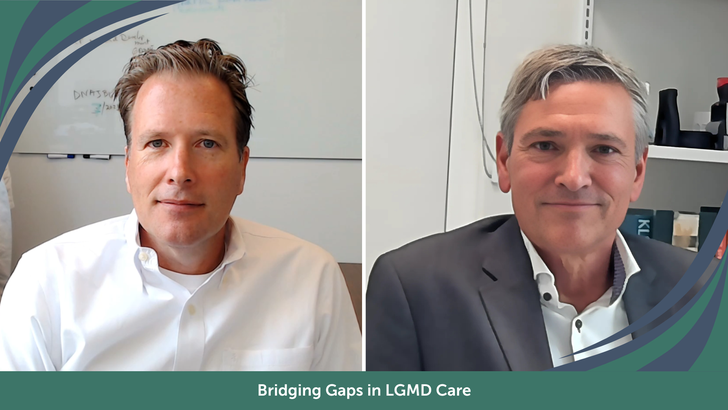
This is CME on ReachMD, and my name is John Vissing.
Dr. Weihl:
And I'm Conrad Weihl.
Dr. Vissing:
And in this episode, we will dive into how it is living with limb-girdle muscular dystrophy type R9. One of the issues here is the psychological burden of living with the disease, and, Dr. Weihl, how do you go about this in clinical practice?
Dr. Weihl:
Yeah. I think that's a great question and something that all of our patients are challenged with. I think the first thing I do is ask and just try to understand if there's things going on that maybe are challenging that I don't understand. I've come to start asking patients some questions that I think are important, which is how often do you get out of your home? I've been surprised to find the challenges that it takes for the patient to even get to the doctor’s office, and imagine the effort that it takes to the doctor's office and translating that to get to church, to get to a community center. And so I try to really understand what some of their limitations are and let them explain it to me and explain why I think it's important for them to continue to interact with the community and things of that nature.
Another thing that I think is helpful is connecting them with patient advocacy groups or other patients. And I shouldn't say, necessarily, other patients as much as patient advocacy groups that are present, even disease-specific. There are some patient advocacy groups focused on limb-girdle muscular dystrophy 2I. And I find that them knowing that there are other patients out there, them knowing that they're not alone, them knowing that their caregiver can reach out to other caregivers can be really important. So I find that to be helpful.
And as I mentioned, caregivers. I think also acknowledging the burden on the patient, but also the burden on the caregiver and really asking the caregiver, do you have support? Do you have help? What do you need? Those are some things that come to mind immediately.
How about you, John?
Dr. Vissing:
Well, I agree with a lot of the things you have talked about. We do group consultations where we have usually 6 persons. They have all agreed, and I think this is really a wonderful experience for me as a doctor but mostly for the patients because they really want and they get to know other questions that they wouldn’t have asked themselves. And if they agree to this, this is, I think, something which is psychologically very nice for the patients.
We also, on a yearly basis, have patient meetings usually in the auditorium of the hospital where we tell them about ongoing studies and such things. And I think a really important part in these patients’ lives is when they get the diagnosis. There, they are really hit by a big truck and need psychological support in this time. And it has been very difficult, I think, and I know many places around the world, it's very difficult to get psychological support for this. But we are trying to do this now, getting group therapy, cognitive therapy to not only this muscular dystrophy but other newly diagnosed muscular dystrophies, as well
So this was a great discussion. Thank you very much. And thank you for listening in.
Announcer:
You have been listening to CE on ReachMD. This activity is provided by TotalCME and is part of our MinuteCE curriculum.
To receive your free CE credit, or to download this activity, go to ReachMD.com/CME. Thank you for listening.